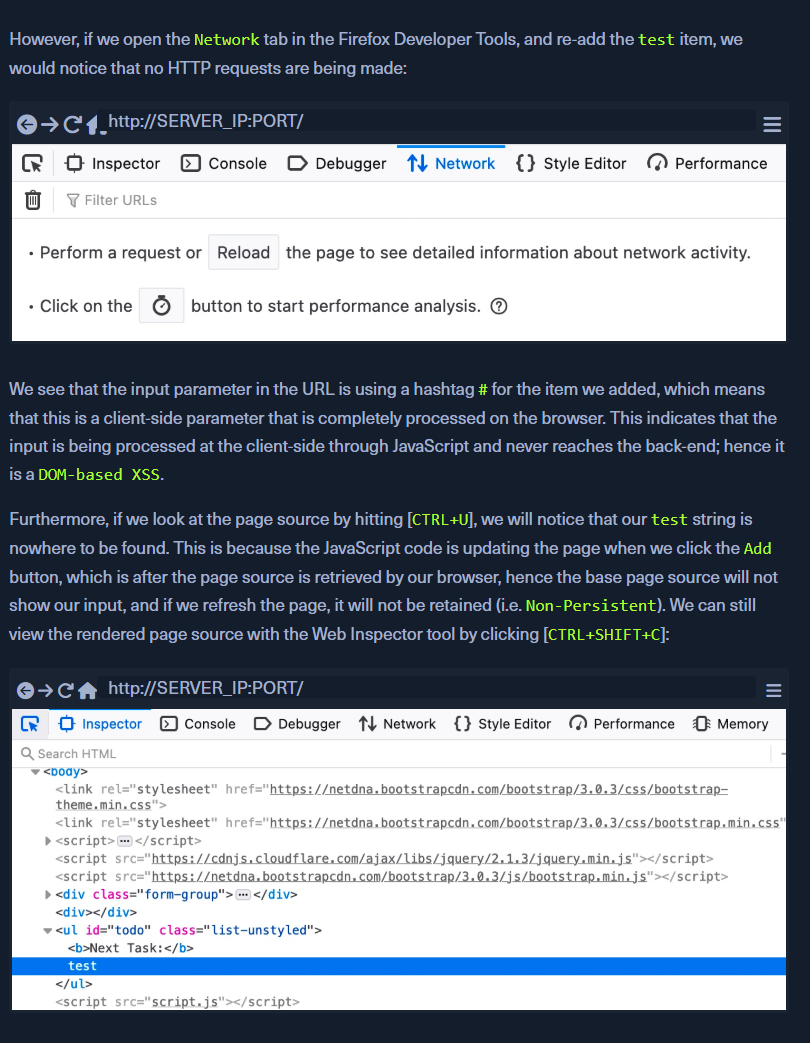
this is a non-persistent type called DOM-based XSS.
Other 2 types send the data to the backend servers.
DOM XSS is completely processed on the client side through JavaScript.
DOM XSS occurs when JS is used to change the page source through the DOM.
Example:
When we send the user input in a text-input field the user input is reflected on the page.
In other 2 cases, there is a request being sent to the backend server when a user-input is entered.
Source & Sink
The Source is the JavaScript object that takes the user input, and it can be any input parameter like a URL parameter or an input field, as we saw above.
the Sink is the function that writes the user input to a DOM Object on the page.
If the Sink function does not properly sanitize the user input, it would be vulnerable to an XSS attack.
Common JavaScript functions to write to DOM objects are:
document.write()
DOM.innerHTML
DOM.outerHTML
some of the jQuery library functions that write to DOM objects are:
add()
after()
append()
DOM.innerHTML does not allow the <script> tag.
<img src="" onerror=alert(window.origin)> - use this payload