A binary such as rundll32.exe can be used to execute a DLL file. We could use this to obtain a reverse shell by executing a .DLL file that we either download onto the remote host or host ourselves on an SMB share.
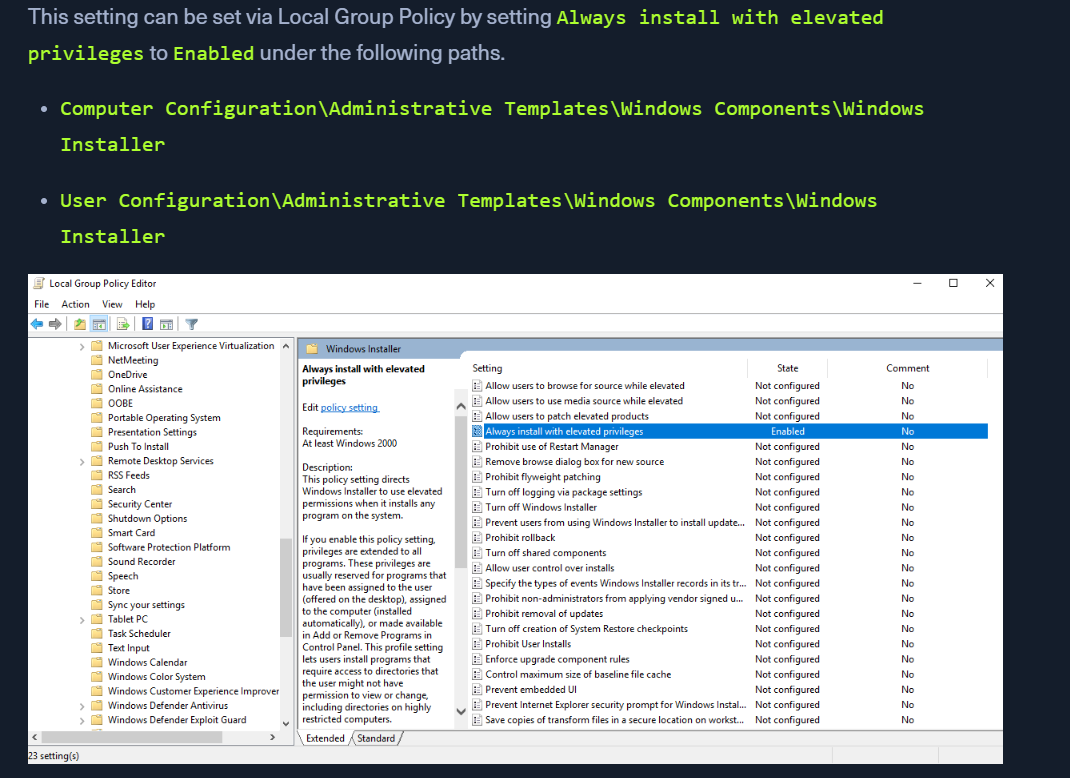
This issue can be mitigated by disabling the two Local Group Policy settings mentioned above.
CVE-2019-1388
CVE-2019-1388 was a privilege escalation vulnerability in the Windows Certificate Dialog, which did not properly enforce user privileges. The issue was in the UAC mechanism, which presented an option to show information about an executable's certificate, opening the Windows certificate dialog when a user clicks the link. The Issued By field in the General tab is rendered as a hyperlink if the binary is signed with a certificate that has Object Identifier (OID) 1.3.6.1.4.1.311.2.1.10. This OID value is identified in the wintrust.h header as SPC_SP_AGENCY_INFO_OBJID which is the SpcSpAgencyInfo field in the details tab of the certificate dialog. If it is present, a hyperlink included in the field will render in the General tab. This vulnerability can be exploited easily using an old Microsoft-signed executable (hhupd.exe) that contains a certificate with the SpcSpAgencyInfo field populated with a hyperlink.
When we click on the hyperlink, a browser window will launch running as NT AUTHORITY\SYSTEM. Once the browser is opened, it is possible to "break out" of it by leveraging the View page source menu option to launch a cmd.exe or PowerShell.exe console as SYSTEM.
Exploitable for versions - https://web.archive.org/web/20210620053630/https://gist.github.com/gentilkiwi/802c221c0731c06c22bb75650e884e5a